Learning and Teaching Languages

Learning and Teaching Languages

Kiyomi-sensei in Gulfport, Biloxi

My name is Kiyomi Ogawa. I am a Japanese-language teacher and my husband is an American translator. We love languages and have published six Japanese textbooks. I’m very grateful for this opportunity to connect with Seedtime Multilingual.

I’ve been teaching Japanese both online and in person, and my students are learning Japanese for many different reasons. The main reason, of course, is that they love Japan! Most of my students like Japanese pop culture such as anime and video games, but some are also attracted to traditional Japanese food, culture, and natural beauty. More than a few are taking lessons to learn Japanese phrases for travel.

Next are the people who learn Japanese for work. In Japan, there are many international industries ranging from cars and electronics to medical devices. I teach classes for people who want to work in those industries. The curriculum for these classes generally covers topics such as job interviews and business discussions, although some people have told me that they use English for work but still need to learn Japanese to build stronger bonds with their Japanese colleagues. 

On the other hand, some are not so interested in Japan itself. They simply love languages. I’m one of those people. Ever since my childhood, I’ve been very excited when I encounter foreign languages. It feels like visiting a country I’ve never been to. Not to mention that by learning a language, you can learn about a whole new world that has unique customs, culture, and history.

A few years ago, I had a Chinese student. Her Japanese was at an advanced level, so I selected some articles from a news website. Some of the articles appeared to be blocked in China, and upon realizing this the student’s eyes got wider and she looked a little tense. After the lesson, I regretted showing her the articles; however, she left a comment: “Thanks to Mrs. Kiyomi, I felt like a new window was opened for me.” Languages truly are a portal to another place.


https://kiyomisensei.amebaownd.com/pages/2612637/page_201902161718

original illustrations by the author
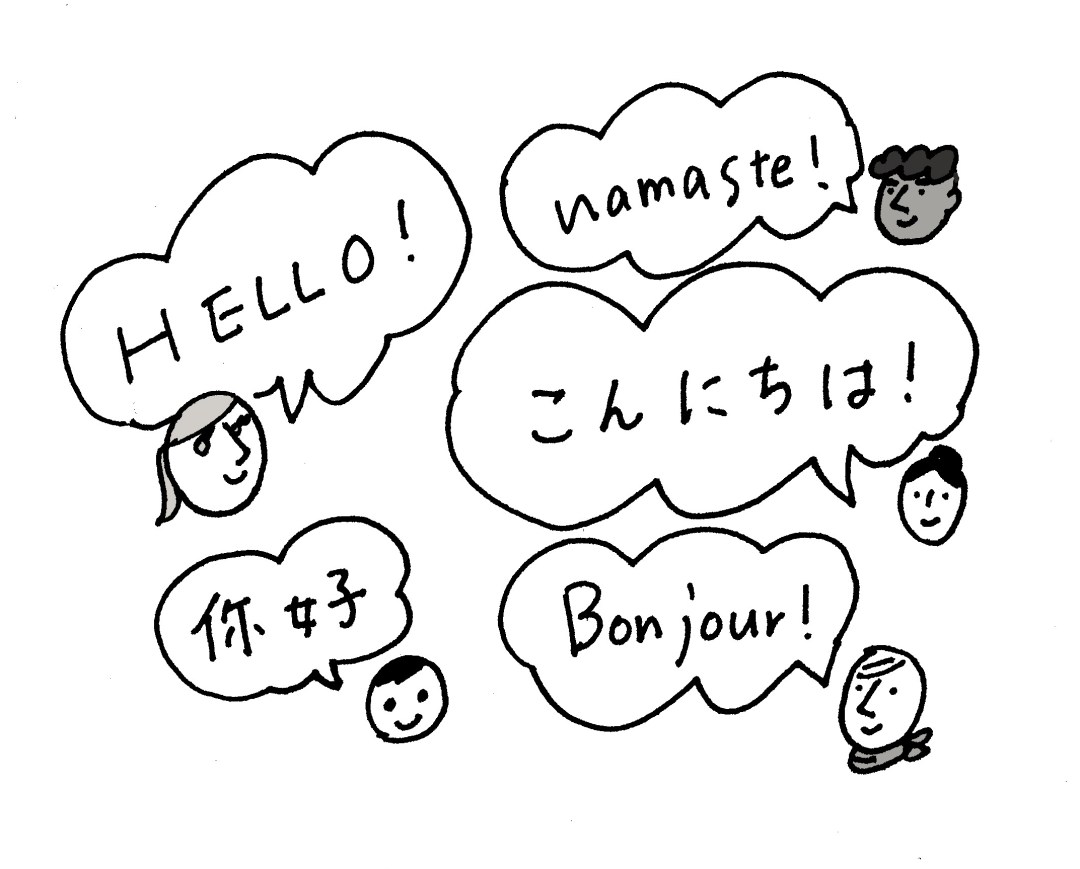
 

Learning a language is also an opportunity to change your life.

One of my students was bullied when he was young, and this kept him from having confidence in himself. Though he was initially negative about everything, he was eventually able to overcome this by speaking Japanese.

That student’s first encounter with Japanese was a toy from his Grandma. The toy  spoke Japanese, and he thought the sound was so funny so he copied it. People around him were amused by that, and it made him feel like a star. He started learning Japanese seriously, and he looked so happy during the lessons. I couldn’t believe that he used to be an introverted and quiet person. That confidence didn’t remain limited to Japanese, either—he started doing other new things too, like working out and taking music lessons. He finally became the person he wanted be.

Some might say that studying something is meaningless if you never use it. Languages, however, are gateways to worlds brimming with unknown possibilities for you. I met my husband thanks to our mutual love of languages, after all!

I hope many people can enjoy many such wonderful experiences!

Japan and the US, Difference in Communication?

Japan and the US, Difference in Communication?

こんにちは

Konnichiwa (Hello)!
 
My name is Mizuki Umebara. I am based at Delta State University in Cleveland, MS, and I have been introducing Japanese culture mainly in Delta region since August 2022.
 
I came to Delta State University as a Japan Outreach Initiative (JOI) Coordinator. JOI program is a two-year program, which aims to promote awareness and understanding of Japan by bringing volunteer Japanese coordinators to regions of the U.S. where there is relatively limited access to Japanese culture.
 

Mississippi Life

My life in Mississippi is full of new experiences. This is my first visit to this country. I have seen many American movies and have learned English since middle school, so I had a picture in my mind what American culture and society would be like.  Yet, there are so many things that you would never know unless you actually visit or live in the country.
One example I noticed is that American people wish others good luck a lot. In a conversation, people almost always conclude with a phrase like ‘Have a good day’ and ‘Take care’.


Communication Differences 

In Japanese society, we don’t greet like that. We usually tend to only say, ‘See you’.  Wishing others good luck may be natural for most American people, but every time someone says “Have a good day’ to me, I feel so happy, and I reply ‘You too’ with my appreciation.
 
The other example that is related to how people communicate in the US, particularly in South, and that I was a little shocked when I was called first, is that young people use ‘Sir’ and ‘Ma’am’ when they call an older person. I felt like I was a very old person. However, I learned that this is a way of showing respect to others. Speaking of showing respect, Japanese language has “honorifics,” which is used from a young person to an older person, or in a business situation. I thought English is a very friendly language in general, but it is very interesting we have a similar concept in the different languages.
For me, learning different culture and languages are something that broaden my horizon.  The understanding lets me gain new perspectives and values, and enrich my life.  I hope you will find the same joy through your own journey in learning about a foreign country. It would be great if you felt an interest in learning about Japan, Japanese culture and Japanese language on your way!
 
 Mizuki Umebara, Japan Outreach Initiative Coordinator (Aug.2022 – July.2024)
Official Instagram: @mizuki.in.mississippi_joi
The Quest for Gold in the Foreign Language Classroom

The Quest for Gold in the Foreign Language Classroom

Most are familiar with Mark Twain’s quote: “all that glitters is not gold.”

Mr. Ballou said I could go further than that, and lay it up among my treasures of knowledge, that nothing that glitters is gold. So, I learned then, once for all, that gold in its native state is but dull, unornamental stuff, and that only low-born metals excite the admiration of the ignorant with an ostentatious glitter.


However, like the rest of the world, I still go on underrating men of gold and glorifying men of mica. Commonplace human nature cannot rise above that.”

From Mark Twain’s “roughing It” (1872)

 The Deep Dig

The above quote and response by the character Ballou captured my attention in the Notable Quotable section of the Wall Street Journal (2013). Now, as then, it still resonates within me. I can relate my foreign language teaching experience to its moral and philosophical lesson.

For example, though honorable and representative of best-in-class effort, it is hardly enough for me to shine bright in the ranks of graduates from the Michigan State University, Master of Arts in Foreign Language Teaching, (MAFLT) program. I covet the accomplishments of fellow Japanese language teachers, whose Advanced or Superior proficiency levels will outshine and exert influence for which I am still working to attain.

Most importantly, language teachers not only attain and instill the quest for high performance and language proficiency, but we also teach target language culture, which temper our student and build character. They find brilliance within themselves. I experience a richness in language teaching and learning that can only be mined, which means digging to great depths in pedagogical skills through personal development and life-long learning.

Finding the Hidden Nugget

My goal to become a great teacher can be compared to digging well beneath the surface of language teaching glitter. I seek to serve the underserved communities that have disproportionately low numbers of students with exposure to Japanese language and culture. Language teaching is a painstaking labor, even with the ideal student and environment. In my “gold mining” analogy: climbing mountains, carrying tools and resources, like picks, shovels, and blasting twine and fuse, I “[strive] with might and main” to reach the disadvantaged, bring the best out of each student, and motivate them through their learning experience. There is a hidden nugget in every language learner, waiting to shine.

A Career Expo Focused on Eighth-Graders

A Career Expo Focused on Eighth-Graders

Seedtime Multilingual participated in the annual P2P. This amazing event hosts professional organizations to encourage 8th graders to select a career pathway! We were invited and provided interactive cultural activities to students who visited our booth section.

Class review videos to help short-term memory

Class review videos to help short-term memory

Seedtime multilingual offers online courses in Japanese, Spanish, and English for English Language Learners.  Planned  courses will also include: American Sign Language, Arabic, Korean,  Mandarin Chinese, and Vietnamese

The 10, 12, and 16-wk courses consist of 10 – 15 Modules. Students meet (on-site or online) with a teacher every two weeks for live conversation practice.  Upon completion of 10 modules, conversation classes will be conducted mostly in the target language.

We are presenting an example of a Beginner Japanese class review video.  In this video, we are using the Dr. Moku Free Hiragana Chart.

Additional charts can be found at:
Free Hiragana Chart (drmoku.com)